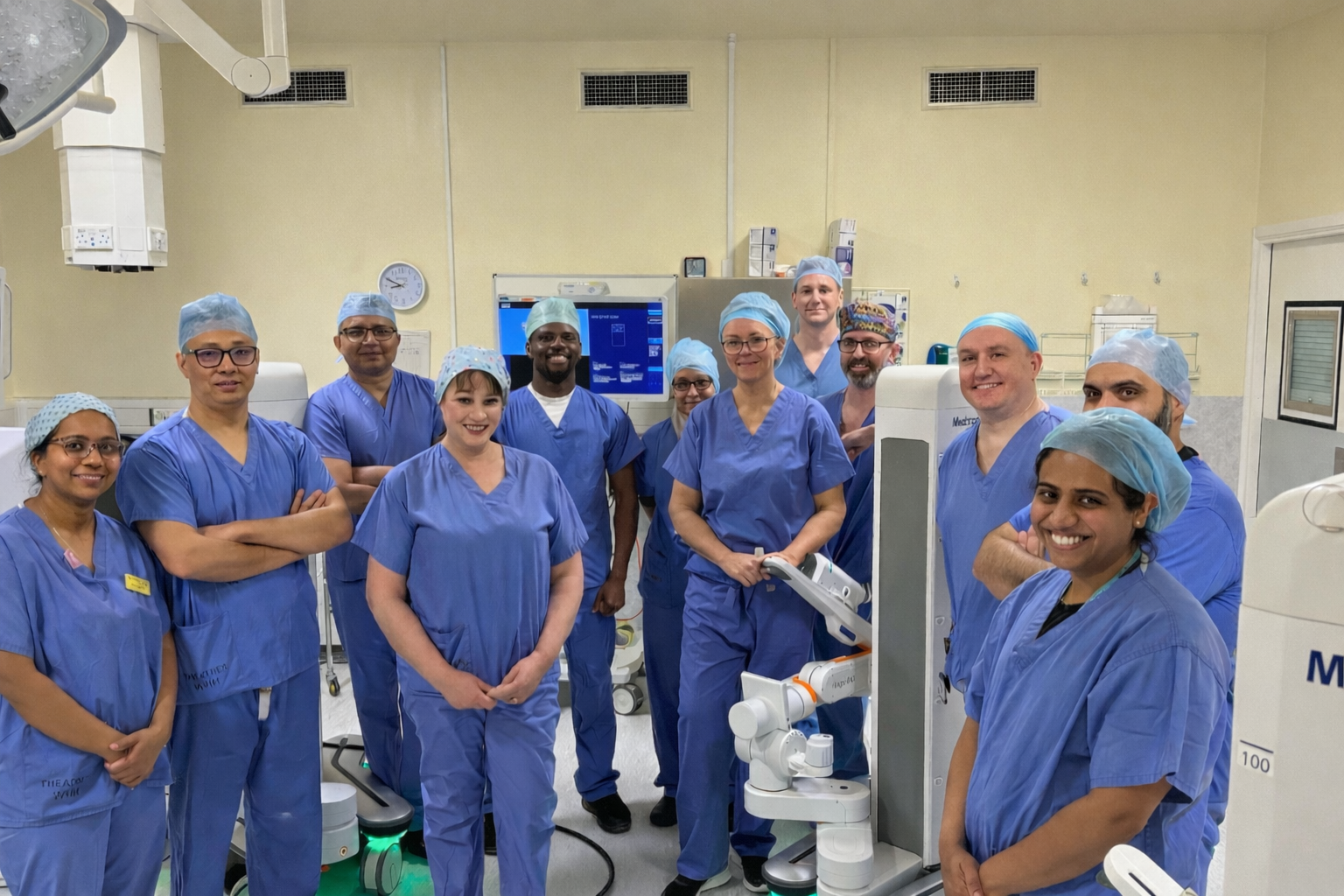
First patients have robotic surgery at William Harvey Hospital
A retired engineer was one of the first patients to have robotic surgery at the William Harvey Hospital in Ashford.
John Tebbs had part of his bowel removed using the new multi-million-pound Medtronic HUGO robot, in a procedure performed by consultant colorectal and general surgeon Mr Ashish Shrestha.
The 74-year-old was diagnosed with pre-cancerous cells in the colon at the end of last year and underwent surgery on Wednesday 4 February.
He said: “I have always had an interest in engineering skills and design, so when Mr Shrestha mentioned that they had this new robot and asked if I would be his first patient, I jumped at the chance.
“It was my first operation, apart from having wisdom teeth removed many years ago, so I don’t really have anything to compare it with, but I was able to go home after two days.
“There was a chap on the ward who had the same procedure the old-fashioned way, and he had to stay for six days, so I think I definitely had a faster recovery.”
John was diagnosed after suffering from diarrhoea. Tests revealed blood in his stool, and a colonoscopy found a 33mm growth in his colon.
He said: “I had absolutely brilliant care, right the way through. I think the hospital gets a lot of adverse publicity but I couldn’t fault them.
“From the colonoscopy to the surgery and recovery, there were fantastic people looking after me and I will always be grateful.
“Ironically, I had the bowel screening test through the post two days after my colonoscopy, so I would really advise people to do it, because you never know what is going on inside.”
The Medtronic HUGO robot is the first to be installed at the hospital and follows the use of a Da Vinci robot at the Kent and Canterbury Hospital for patients needing urological surgery. A HUGO surgical robot was also installed at the Queen Elizabeth The Queen Mother Hospital in Margate this year.
Fellow bowel cancer patient Paul Scrivens and his wife Karen raised £2,000 at a coffee morning, which he used to buy specialist chairs for the surgeon operating the robot. He was also able to fund two large wall-mounted screens for the theatre to allow more people to see what the surgeon sees inside the body.
Paul, who runs engineering firm Hatch in Charing, said: “I wanted to say thank you to the whole department who have looked after me so well.
“Without them I don’t know what might have happened. I can’t fault the whole NHS system.
“Although I wasn’t able to have robotic surgery, it’s fantastic that more patients in the future will be able to benefit from this, so we wanted to do our little bit to contribute to that.”
Mr Shrestha said: “I am delighted we can now offer robotic colorectal surgery at the William Harvey Hospital.
“This technology offers faster recovery, less pain and access to the most advanced techniques. We are very grateful to Paul for his fundraising and look forward to treating more patients.”
He added: “A huge thank you to everyone involved in delivering our first successful cases with the HUGO robot. This achievement reflects outstanding dedication across clinical teams and management.
“I would particularly like to recognise the theatre, anaesthetics and nursing teams, whose preparation made this possible. This technology enables us to deliver world‑class, minimally invasive care to our community.
Mr Prashant Naik, who carried out the first robotic procedure and whose patient also had an excellent outcome, said: “I am proud that we can now offer our patients a new standard of precise, minimally invasive surgery with the HUGO RAS robotic platform, which improves surgical dexterity, visualisation, and control for complex colorectal procedures.”
Senior surgical care practitioner Larissa Williams said: “The precision and control of the robotic platform allow smoother dissections, less tissue trauma and greater accuracy. Most importantly, patients benefit through smaller incisions, fewer complications and faster recovery. Investing in robotics equips our teams to provide safer, more advanced care.”
The NHS National Cancer Plan aims to expand robotic cancer surgery from 70,000 procedures a year to 500,000 by 2035.