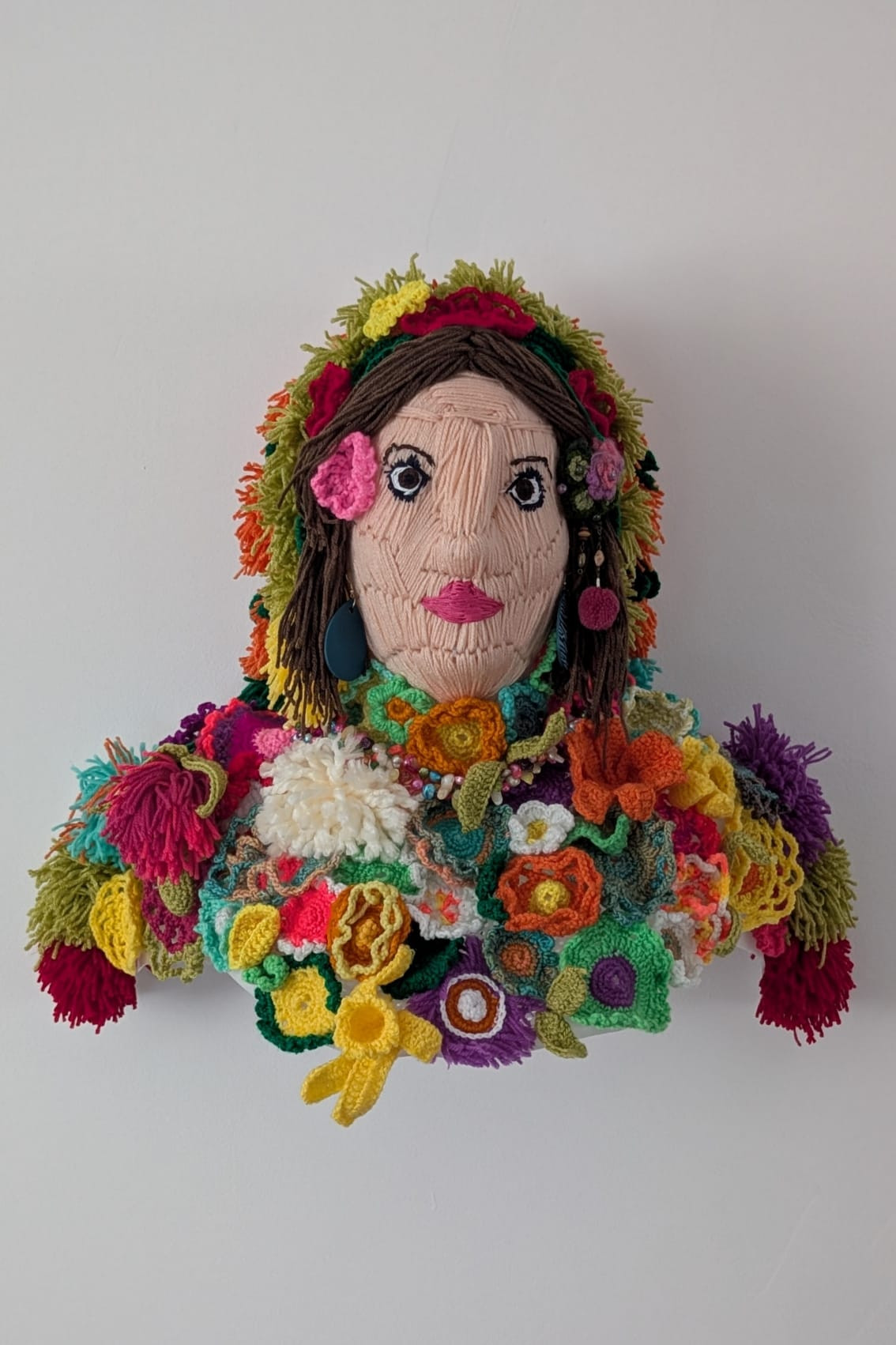
Juliette's mask is a reminder of hope
A creative nurse has transformed the mask used for her radiotherapy treatments into a work of art.
Juliette Beaumont had to wear the custom-made device as part of her treatment for cancer at the Kent and Canterbury Hospital. It was specially created to mould to her face, and used to strap her to the treatment table for 20 minutes at a time, five days a week, for seven weeks.
After her sessions ended, Juliette, from Ramsgate, wanted to create something positive instead of focusing on the side effects so decorated it with flowers she had crocheted during her treatment.
Juliette said: “I’m quite a creative person and I learned to crochet during my treatment as a distraction - something that helped me relax and take my mind off the side effects.
“The mask has all these holes in it, and I thought I could decorate it with flowers, so over the months I made more and more of them.
“During treatment, the mask keeps you tightly strapped to the table and you can’t even open your eyes or your mouth – you really can’t move a muscle.
“I thought decorating it was a way to make something positive out of it, and I will have it on display at home as a reminder that there is still beauty in the world.”
Juliette, 50, was diagnosed with cancer at the base of her tongue last summer, after finding a lump in her neck.
Tests confirmed it had spread to her lymph nodes and she faced a gruelling treatment programme, with weekly chemotherapy alongside the daily radiotherapy sessions.
Although it successfully eradicated the cancer on her tongue, she needed surgery to remove her lymph nodes, which took place last month.
She said: “Even though I was expecting the diagnosis after finding the lump, it was still a massive shock.
“The surgeon said he wanted to make sure I didn’t leave without taking on board that treatment was going to be brutal.
“And it was. He made sure I knew what I was facing, which was really helpful. He told me to go home and eat and eat because there would be a time when I couldn’t, so we had a lovely few weeks enjoying lots of meals out before my treatment started.”
Juliette, who works in the critical care unit at the Queen Elizabeth The Queen Mother Hospital in Margate, was fitted with a feeding tube as it became too painful to eat and drink.
She developed multiple ulcers in her mouth and throat, severe pain, her voice was affected, and her taste changed, leaving everything tasting of salt. Longer-term effects include swelling in her neck (lymphoedema), fatigue, pain, swallowing problems and reduced movement in her arm. She also has to complete tongue and swallowing exercises several times a day, as well as exercises for her neck to help with the reduced range of movement and swelling.
She said: “I’m officially cancer-free now, but I’m not celebrating yet. Although I feel positive, in other ways it feels strange. I think that is because I still have a lot of healing to do, and to get used to my new normal.
“I have to have check-ups every six weeks, with a camera to look inside my throat, because the risk of recurrence is highest in the first two years.
“But the team who cared for me are really incredible people and I felt really looked after. Waiting for the results was hard but once I had a diagnosis I felt cocooned by everyone.
“I saw the speech therapist, dietitian, Macmillan support worker and oncologist every Monday, but they were at the end of the phone the rest of the time if I needed them.”
Juliette wanted to say a huge thank you to all the staff in oncology services at the Trust, as well as the many other staff members she met along the way.
She said: “This has been the worst time of my life, and I am so grateful for their kindness and compassion.
“I would also like to thank my wonderful partner John, and my close friends and family who have been so supportive.”
Juliette hopes to be able to give something back when she is fully recovered, from taking her decorated mask to a support group for head and neck cancer patients, to sharing tips that helped her cope.
She said: “I would love to help other people. The treatment and recovery is really traumatic but there are things that help.
“The first time I had radiotherapy, there was a sad song playing in the treatment room. This caused me to feel distressed and want to cry, which wasn’t really possible because I couldn’t move at all.
“After this, the support worker explained that I could ask for any music or song to be played and all I had to do was ask. After that the wonderful radiographers played Wham at my request for every session which helped get me through the 35 radiotherapy sessions and made everyone smile.
“I also listened to Dame Deborah James’ audiobook and she said a lot of things I needed to hear.
“I realised other people felt the same, and that was a huge comfort to me.”
Juliette’s cancer was caused by human papillomavirus (HPV) so she is also encouraging others to be vaccinated if they are eligible and to never ignore any unexplained lumps that may appear – contact your GP and get checked.