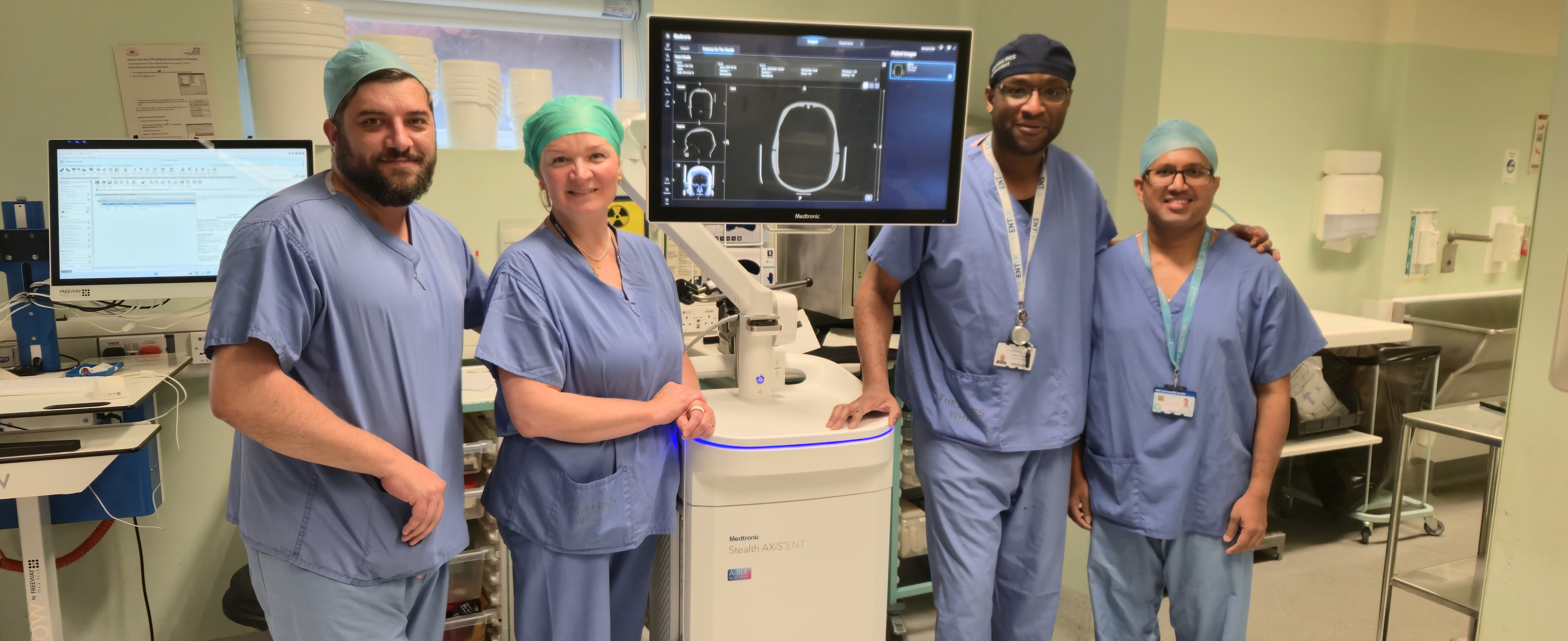
UK first for William Harvey ENT team
East Kent Hospitals clinicians have become the first in the UK - and the second in Europe - to use a new high-tech system for endoscopic sinus surgery.
The new Stealth AXiS™ ENT Navigation image guidance system uses CT imaging to help surgeons navigate the complex anatomy of the nasal sinuses. It allows them to see on a screen where their instruments are relative to the patient’s own individual anatomy, improving confidence and precision during procedures.
Surgeons still need to rely on their anatomical knowledge, experience and interpretation of preoperative CT imaging. But the new system, developed by Medtronic, provides additional real-time anatomical guidance to support surgical confidence and potentially enhance patient safety.
Mr Eugene Omakobia, consultant ear nose and throat (ENT) surgeon and rhinologist, who carried out the procedure at the William Harvey Hospital in Ashford, said it was an exciting milestone.
He said: “It was a privilege to be involved in introducing this next-generation surgical navigation technology into clinical practice, with the support of the Medtronic team.
“As a consultant rhinologist, I am particularly enthusiastic about advances in technology that can support surgical precision, improve operative confidence and potentially enhance patient safety.
“I am proud to be at the forefront of innovation in endoscopic sinus surgery in the UK, and grateful to our dedicated theatre team and colleagues at Medtronic for helping to make this possible.”
The first patient was retail worker Scott Norton, 32, from Dover, who had a polyp removed from his nose.
He said: “I’m glad to be able to be part of this, and to potentially help with training of other surgeons in the future.
“It was very straight-forward from my point of view and very quick – I was only under for an hour if that.”
The system is particularly useful in complex cases, especially revision surgery where normal anatomical landmarks may have been distorted or removed, and when operating close to critical structures such as the eyes, optic nerves and skull base.
Image guidance can support more precise surgery in anatomically complex cases and may help reduce the risk of complications. Whether a patient needs further surgery also depends on the underlying disease and other factors.
Mr Omakobia said: “Not every patient who needs sinus surgery will require image guidance, but the system complements rather than replaces surgical expertise.
“It is an exciting development for our rhinology service, offering an opportunity to combine technological innovation with improved surgical care and potentially better outcomes for our patients.”