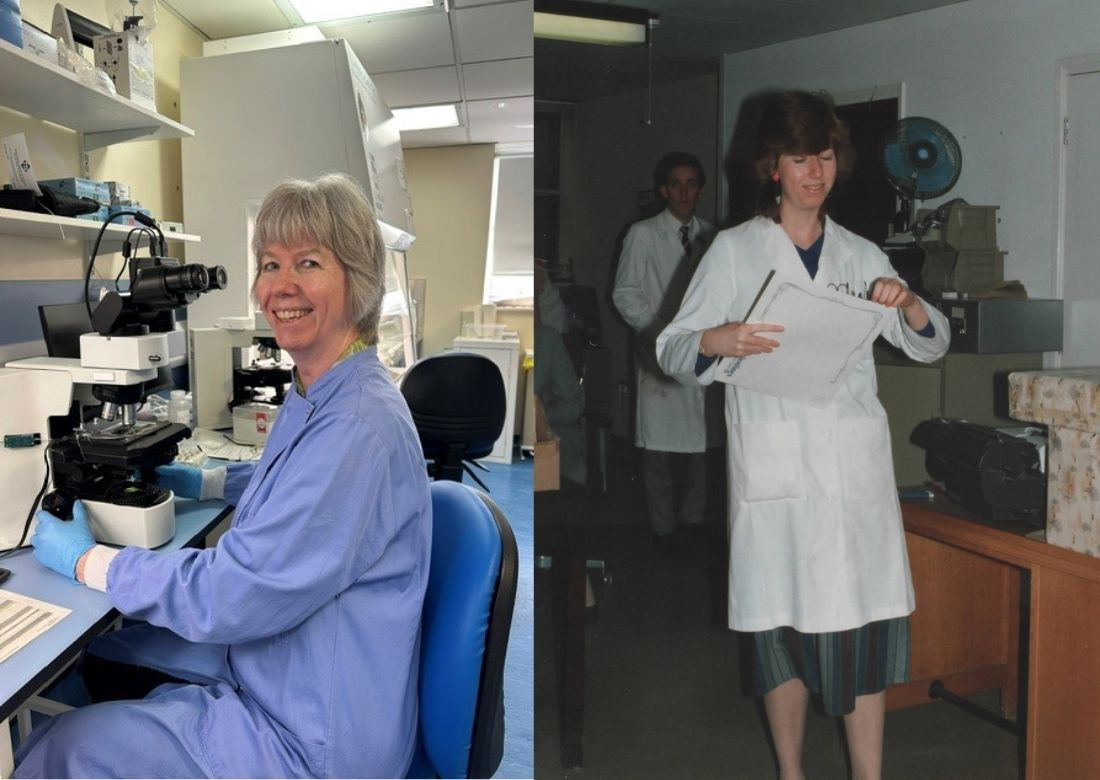
Shirley remembers her 45-year career
A biomedical scientist is finally hanging up her lab coat after almost 45 years.
Shirley Moses has worked with East Kent Hospitals for almost all that time, apart from a brief spell at the John Radcliffe Hospital in Oxford in 1987.
Her first experience in a hospital laboratory was one afternoon a week from school, and at 18 she was lucky enough to be one of the last trainees accepted with A levels.
Since then she has worked her way up from a trainee role to being the chief biomedical scientist responsible for the day-to-day running of the cervical screening service for East Kent. When that was transferred out of the Trust, Shirley and her team were able to concentrate their efforts on the non-gynaecological cytology samples and to expand the andrology service, which examines semen samples for couples experiencing infertility or after vasectomy. Shirley became the senior biomedical scientist with responsibility for the andrology service for patients in East and West Kent.
She said: “I have absolutely loved it. It has been my life’s work, and I am still fascinated by it.
“Screening is my passion and I love being at the microscope looking for abnormalities for people who don’t have any symptoms.”
Shirley has seen many changes over the years, including more use of technology. At the beginning of her career, all results were entered into a large ledger – now they are saved to a patient’s electronic record.
Andrology quality control was carried out using a video cassette of images; now it is completed via an online portal.
She said: “When I started, every single cervical smear was looked at by a screener using a microscope to check for abnormal cells. Human Papilloma Virus (HPV) testing wasn’t brought in until much later in my career and this testing was an additional tool after microscopy.
“Now the samples go through a machine that tests for HPV first and only those that are positive for the high-risk subtypes are checked using a microscope.
“We had a dress code when I started, and all women had to wear a skirt. We all just did it, there were no exceptions, and men had to wear a collar and tie.
“If they didn’t have a tie, the boss had a drawer of kipper ties which were dreadful but they were made to wear one.
“At an interview in 1986 I was asked if I was in a permanent relationship, and if I could sew – presumably to check whether I had the manual dexterity needed to work with the samples.
“I remember being told that men were there for the science and women did the work and this spurred me on as there were very few women in the higher positions within the laboratory.
“We have got to the point we are at now where things are much more equal because people did battle on.”
Although biomedical scientists are involved in at least 70 per cent of decisions around patient care, they rarely get to meet the patients themselves.
But Shirley does often meet couples undergoing fertility treatment.
She said: “The samples need to be at the laboratory within an hour of production and we have always appreciated that this is impossible for many of our patients. After many years of trying we now have access to a production room on site and this has made such a difference to our patients.
“This patient interaction has allowed us to talk through both the practical aspects of the testing process with them and to explain how the results will be presented. It has become apparent that some of them have never spoken openly about their struggles or their fears.
“I think the patient contact has been the most enjoyable aspect of the work; it is really interesting to meet the people behind the sample and it has helped us to understand issues in their fertility journeys which we can learn from and also feedback to GPs at training days.
“I screened cervical smears for 35 years and have been involved with andrology patients for all of my working life. Over the years, I can’t imagine how many samples I have looked at, and that I hope is my legacy; that I will have changed some lives for the better, either through an early diagnosis of a gynaecological abnormality or investigation into subfertility.
“My last week will be very difficult; my colleagues have become friends and I will miss seeing them and playing a part in patient care.”
Friday, May 29, is Shirley’s last day in the laboratory, before she retires. She and her husband are planning to move to Cumbria, where she hopes to become involved with red squirrel conservation and enjoying walks in the National Park.